What is Made by Hand
Wellbeloved Woodworks
My father’s woodshop was tidy and spare. His chisels were placed in ordered rows above his well-worn bench. Stacks of lumber, propped against the far wall, awaited his selection. In the warmth of the lamplight I would listen to the rhythm of his saw, breathing in the scent of wood and sweat that hung about the room long after his work had ended.
The space was small but not crowded, unencumbered by the hulking machines common to most shops. Each piece took its form upon his bench, and later occupied the center space of the concrete floor as my father applied the finish and I marveled from the doorway.
My father was a proud advocate of hand-tool use, and for the years of my youth, he doggedly resisted the alluring efficiency of most powered tools. I envisioned him, chisel and mallet in hand, stoically set against the tide of industrialized woodcraft. At the end of a long day, my father would collapse into the La-Z-Boy, the sweat still beading on his bare chest and arms, and tell me again about the importance of handwork. “Machines dull the experience of the work,” he would say. “You lose the human connection. Machines give you precision, but furniture can sometimes be too precise. The marks of the handplane, the uneven edges, those are human imprints on the wood.”
I needed no convincing. I understood that work should have meaning, and I was proud that his work was meaningful enough to him that he would stand on principle for the sake of his craft. The work was harder, it took more time, but it was his. He authored those pieces in a way that could not be claimed by the machine shops pumping out furniture at three times the speed.
I learned many things about woodworking from my father. Simple things like how to stand when planing, or how to steer a saw. Much of what I absorbed was so engrained, that I wasn’t even aware of having learned it. It wasn’t until I started teaching woodwork myself years later that I realized just how much my father is responsible for how I hold a chisel.
Yet more than all of this, he demonstrated what it means to care for the craft. His work was difficult, physical and slow. The costs were significant, and the burden of his method was always present. But love is like that. And from where I stood, it was his love of the craft that made him willing to take on that burden and carry it lightly.
My father was proud of the furniture he produced in those days. He would emerge from his shop with the dizzying smell of paste wax pouring off of him, offer me a sideways glance, and nod for me to follow. This was my regular invitation to view his completed projects, and they were always beautiful, always deeply reflective of him. But as I walked around the table, or the chest, or the trastero, feeling the newly waxed contours of the wood, my father would inevitably turn the conversation to process; exploring the specific challenges of the work and how they had been overcome.
He would show me how the grain had moved here in unexpected ways, how the tool had stubbornly refused its line. It was the work he wanted to discuss more than the finished piece. The completed project was simply the manifestation of his diligence, his care, and his fidelity to the craft. And in that room, with the shavings still piled in the corner, it was the process that mattered.
My father's shop was in the garage of our small house, nestled on the eastern side of Sunlit Hills on the outskirts of Santa Fe. My father made furniture in the Spanish colonial style native to New Mexico. It is an anachronistic style, emerging in the seventeenth century from an incongruent blend of ornamental European design and the rustic isolation of this high desert landscape. In those days, quality timber was limited, and the tools that made the voyage from Spain to present day Mexico and north to Santa Fe were scarce and rudimentary. The craftsmen who continue to pursue the form most artfully today understand the role that deprivation played in the development of the style. The lines are crooked, the thickness uneven, the fit imperfect. The style succeeds both in spite of and because of these defects. When done correctly, the traditional furniture of Northern New Mexico embodies the human determination to pursue artistry and craft in the face of limitation and hardship. It is a style that was very well suited to my father's ascetic temperament.
And he was successful on his own terms. He sold his furniture through a high-end gallery to a steady stream of wealthy tourists. Loaded into the truck, we would deliver each piece to the gallery with my sister and I in the back, mindfully attending to it along the way. I remember the two of us clinging to furniture over the bumps in the dirt road, shielding the wood from the hard metal sides of the truck bed. When a certain piece would become too popular, he would stop making it because the life had gone out of the process. As stubbornly wedded as he was to traditional methods, he was always searching for new and untested ways to apply his skill. He needed to be challenged, both physically and artistically, and he surrendered neither for the sake of comfort.
After nearly two decades in Santa Fe, my father was restless. Around the time my sister and I graduated from high school, he decided to move on. He had spent many years in the Virgin Islands as a young man, and he was eager to return. It was a drastic climatic shift, and it marked a significant change to his craft as well. He wanted to fulfill a long-deferred dream of building a house, and I spent a summer on St. John helping him with the construction. The work was challenging. We lived in small tents, showered at the beach, and did all the work ourselves. It was my first exposure to prolonged manual labor, and I was in awe of my father's work ethic. Where I quickly became frustrated, tired, bored, my father worked with a fever. I had learned the perfunctory skills necessary for the job, but I didn’t yet understand that the ability to do physical work day after day is itself a skill that requires practice and repetition.
It took time for my father to adapt to the differences between construction and fine carpentry, but once the house was completed, the power tools hung around. My father worked in a few different machine shops on St. John, and over time he began to adopt many of their practices in his own. He would tell me about the efficiency and the accuracy of machine tools as though the scales had fallen from his eyes. For my father, always in search of new horizons, this gravitation toward machine work was just another part of his evolution as a craftsman. The furniture he produced was still his own. He still broke his edges with a chisel, and the aesthetic he had developed over years working in the Spanish Colonial style somehow found new expression in his island home. Still, I bristled at the sight of the machine tools that had taken up residency in his new shop.
His turn toward machine work occurred at roughly the time I began taking up woodwork myself. I was in graduate school, and felt an increasingly desperate need for physical work. I slowly began acquiring tools, eventually making a workbench, which doubled as a kitchen island in my first apartment. It never really occurred to me to buy power tools, though they were generally cheaper and far easier to find. I needed physical exertion, and was happy to slog through hours of planing or sawing, though my tools were dull and my technique unrefined. I would call my father and tell him excitedly about the new tool I had acquired, or the new method I had discovered. I remember asking him how to make a channel for a desk I was working on, and a week later receiving his rabbet plane in the mail. Sometime later, when I went to visit him on break from school, he presented me with a Stanley smoothing plane that had belonged to my great grandfather. He thought it would get more use with me.
This gradual inheritance of tools I had long coveted was bittersweet. I was happy for the tools of course. But it was difficult to witness my father divest himself of hand-tools at precisely the time when I was becoming passionate about them. Unlike my father, I had the modern advantage of internet research, which offered a vast digital resource of arcane knowledge on the subject of antiquated woodworking practices. I soon learned that not only had my father practiced his craft largely without the aid of modern machinery, but that there was an entire universe of pre-industrial hand-tools that he had also been without.
Whenever I would speak to him about these new discoveries I had made, I would sense the distance in his response. I wanted to reach the woodworker from my childhood, the one who had set my compass and determined my orientation to the craft. But he would needle me with questions: "Do you really want to work that way? Wouldn't you rather just get a table saw?" It felt like a betrayal. More than that, I felt bereaved that my point of departure in woodworking, that shop of my memory and the man who inhabited it, appeared irretrievably lost.
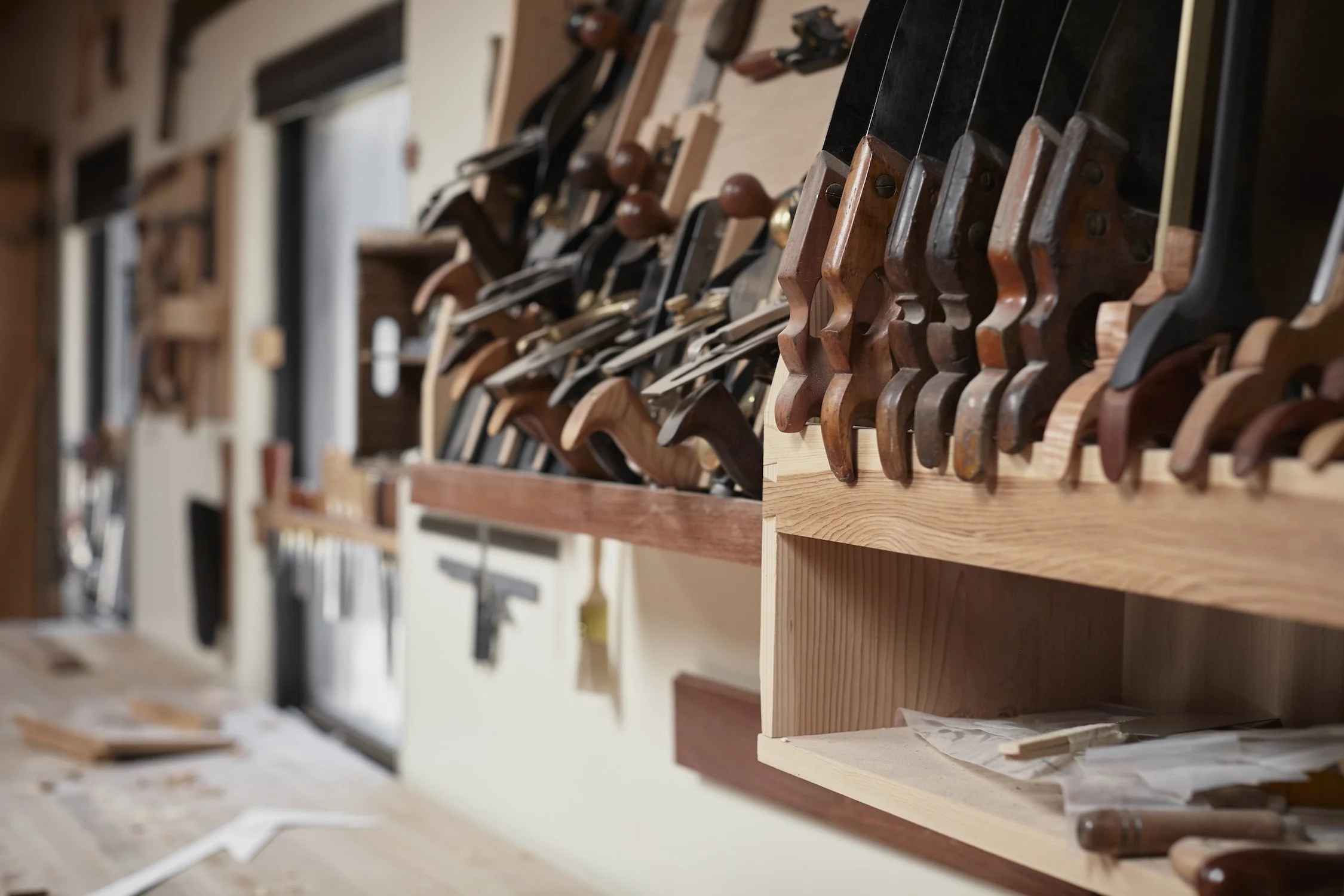
Woodworking remained a passionate hobby of mine as I pursued an academic degree and later began teaching at a small college in upstate New York. My array of tools grew, soon surpassing what I increasingly recognized to be the meager collection from my father's erstwhile shop. I had a jointer plane, a jack plane, a block plane, a scrub plane, a shooting plane, a router plane, and a hundred year old combination plane that did the job of twenty planes in one. I no longer spoke to my father about all the new tools I had acquired, or the new methods I had learned in using them. We would speak in more general terms about woodworking; which projects we were working on and how they turned out. But talk of method was increasingly limited.
When I would visit my father, I would invariably find myself among his tools again. Glancing past the new machines with strained disinterest, my eyes would seek out the old tools from my memory, now relegated to dusty corners of the shop. Uncovering an old Japanese paring chisel, I picked it up and held it closely, examining the elegant shape of the blade, and the rich patina of the handle. My father watched me for some time before blurting out: "Hey, I don't like you looking at my chisels that way. I try to keep them sharp, but the sea air just rusts everything." I was surprised by his reaction, and tried to explain that I was appreciating the tool, not assessing its decline.
Still, the interaction revealed a lack of trust and understanding between us. The rift was made all the more frustrating by the fact that it had opened across this rarefied space that few people understood. I began to doubt the degree to which we practiced the same craft at all. The man I wanted desperately to share my passion with was the man of twenty years ago, and two thousand miles away.
A few years later I left academia and returned with my wife to Santa Fe. I took up woodworking professionally; determined as ever to work without machines, to put my archaic knowledge to use, and to practice the romantic vision of the craft I had received as a child. I worked long hours, which began to suit me. It took an entire morning to plane a crooked board flat, even and smooth, but I reveled in the process. When my newborn son would cry with colic, I would carry him into the shop and pace across the wooden boards. Singing loudly in determination against his screaming, we breathed in the scent of freshly sawn pine.
Over time, the number of commissions grew, and so did my confidence. I felt increasingly comfortable in the life of a woodworker. But as the work expanded, my body protested. Every project required many hours of planing and sawing just to get the lumber to general dimensions. My lower back ached, and my hamstrings were under constant tension. I found myself increasingly in awe of the age-old craftsmen who had preceded me. It was not so much their precision that amazed me, but their physical ability to process lumber from tree to board by hand. Never before had I appreciated what a marvel it was to have a straight, flat, square board to work with. The basic building blocks of all furniture were astonishing to me.
In time, I relented. I received a large commission, which required the use of machinery, and I couldn't turn it down. My primary shop remained unsullied, but my garage became a place to process lumber. I purchased a machine jointer, a planer, a table saw, and I guiltily indulged in their efficiency. My body protested less, and I had more patience by the time the dimensioned lumber left my garage and entered my shop. Still, the feelings that I should be stronger and more determined, and that I had betrayed some core tenet of the craft have never left me.
My father and I speak every few months on the phone. When I called to tell him the news of my large commission, I revealed, with some hesitation, the purchase of the machine tools. "Good” he said. “Use the machines to get the basic work out of the way, then you can use your hand-tools where it matters." It was the same message he had offered to me many times in the past. The advice was simple and obvious, the kind you offer to an innocent. He didn't rub it in. It was a perspective he had earned over nearly four decades working with wood. The words still felt like a surrender, but that surrender no longer struck me as definitive.
* * *
My son and my daughter flit about the shop as curious spirits, playing in the shavings like fallen leaves. When I can capture their attention, I hand them tools that are older than me, older than my father. I explain how they are held, and how to stand. I tell them that the tools will sing when used correctly, and scream when they are not. They take them in their small hands, and focus on the board beneath them with the intensity of their youth. I feel an umbilical transference of something elemental pass between us. Or maybe it's wishful thinking.
They finish their labors and turn to watch me as I plane a crooked board. I absorb their gaze and feel proud to be performing this work for them. I wonder if they view this labor as meaningful, a task that is worthy of care and sacrifice, worthy of a life's work. They are lulled by the pendular motion of the plane, but their eyes remain focused, almost critical. In a moment they are distracted, and they are gone. I replace the tools above my bench and watch them as they leave; the shavings clinging to their feet, trailing far behind them.